Quick Summary
Explore a smart AI-based accident detection system using YOLOv8, Firebase, and IoT to improve real-time road safety and emergency response.
Full Article
Formatted content with headings, lists & code blocks
Road accidents are a serious issue around the world. Every year, millions of people lose their lives or suffer injuries because help does not reach them on time. The main problem is not just the accident itself, but the delay in reporting and emergency response.
To solve this problem, a smart system called AI-Based Accident Detection and Alert System has been developed.
This system uses Artificial Intelligence, cameras, cloud storage, and hardware devices to detect accidents automatically and send alerts without human involvement.
🧠 What is an AI Accident Detection System?
This system is designed to monitor roads using cameras and detect accidents or fire incidents in real time.
Instead of waiting for someone to report an accident, the system:
- detects the accident automatically
- identifies the location
- sends alerts to authorities
- notifies emergency services
This makes the process faster and more reliable.
1. Admin Dashboard
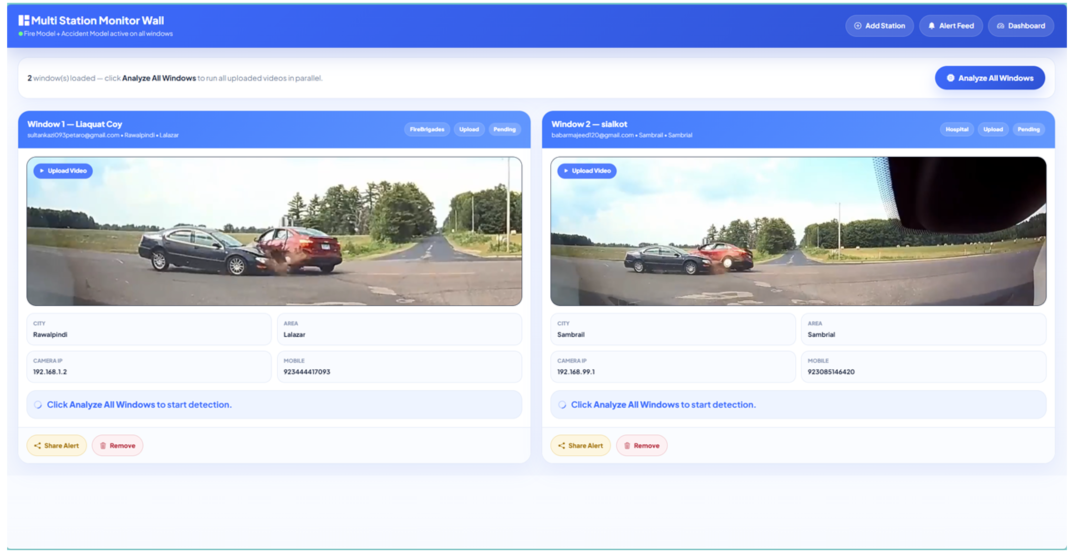
The system starts with a web-based dashboard.
- Admin logs into the system
- Adds station details (police, hospitals, etc.)
- Connects cameras
- Monitors all activities
2. Live Camera Monitoring
Road accidents remain one of the biggest public safety problems in the world. In many cases, the real danger is not only the crash itself, but the delay that happens after it. When an accident is not reported quickly, emergency services arrive late, injuries become more serious, and lives that could have been saved may be lost.
This is where smart technology can make a real difference.
An AI-based accident detection system offers a modern solution to this problem. Instead of depending only on people to notice an accident and report it, the system uses live road cameras, artificial intelligence, cloud storage, and automatic alert tools to detect incidents in real time and inform the right people immediately. Your report presents exactly this kind of solution: a system that combines YOLOv8-based detection, a web dashboard, Firebase, and hardware-based communication to support faster emergency response.
At its core, this system is designed to monitor live traffic camera feeds and identify accident or fire events automatically. Once an incident is detected, the system does not stop at recognition. It also stores the event data, maps it to the correct station, retrieves contact details, and sends alerts through phone calls, SMS, and email. This makes it much more practical than systems that only detect an event without helping emergency teams respond.
One of the strongest parts of the project is its real-time monitoring approach. The system connects multiple road cameras to a centralized dashboard where an admin can manage stations, view feeds, and monitor activity from one place. This kind of setup is useful because road monitoring often involves more than one location. A centralized dashboard makes the system easier to manage and more suitable for real-world use in cities, highways, and busy intersections.
The intelligence of the system comes from YOLOv8, which is used to process video frames and detect accidents or fire incidents. This allows the system to work continuously without depending on human observation. In simple words, the camera sees the road, the AI checks the video, and the system decides whether something dangerous has happened. This is important because human monitoring can be slow, inconsistent, and tiring, especially when many live feeds are involved at the same time.
Another important feature in the project is the use of Firebase Realtime Database. When the system detects an accident, it stores the event details in the database, including information such as the event type, station name, camera source, time, and alert status. This keeps all records organized and makes them available in real time to other parts of the system. In emergency response systems, fast and synchronized data flow matters a lot, and this part of the design helps the full platform work smoothly.
What makes this project more complete is its alert mechanism. Many research projects stop at detection, but your system goes further by connecting the software to hardware modules like ESP32 and SIM800L. Once an accident is confirmed, the system can automatically make a phone call and send an SMS to the concerned person. It can also send an email notification with event details and related evidence. This reduces the need for manual reporting and saves valuable time during emergencies.
The project also adds another useful layer by involving nearby emergency services such as hospitals, police stations, and fire brigades. This means the system is not only informing one station or one responsible person. It is helping create a broader emergency response network. In a real accident, this kind of coordination can be the difference between a delayed response and immediate action.
A major reason this system stands out is that it addresses the gap found in many existing solutions. Traditional sensor-based systems often create false alerts and are usually limited to individual vehicles. Older image-processing methods struggle in low light, bad weather, or crowded traffic scenes. Some AI systems can detect accidents, but they do not include a proper response mechanism. Your project combines detection, storage, mapping, communication, and emergency support in one integrated platform, which makes it much more useful for actual deployment.
This project also fits well into the future of smart cities. As cities become more connected, road monitoring systems should also become more intelligent. A platform that can detect accidents automatically, store information instantly, and contact emergency services without delay is exactly the kind of technology that modern traffic systems need. It improves safety, reduces human dependency, and supports better decision-making during critical moments.
In the end, this AI-based accident detection system is more than just a final year project. It is a practical solution to a serious real-world problem. By using artificial intelligence, live camera monitoring, cloud databases, and automated alert tools, it shows how technology can be used to protect lives and improve emergency response. It is smart, scalable, and highly relevant for today’s road safety challenges.